


This past Thanksgiving, I found myself with time on the road. We live in a city that’s surrounded by a flat expanse of dust and mismanaged farm land for a distance of about two hours by car. The occasional trip out of town is an opportunity to listen to a podcast with my wife so I usually cue up something that I think we’ll both enjoy for our drive down I-5. On this weekend’s trip we listened to a discussion with “the Cultural Tutor” on Chris Williamson’s podcast, Modern Wisdom.
The Cultural Tutor is Sheehan Quirke, an educated thinky type who talks about the arts on X. Having just released a book, The Cultural Tutor: 49 Lessons You Wish You’d Learned At School, he joined Williamson to talk about the need for beauty in the modern world.
We live in a culture obsessed with identifying what is beautiful and what is ugly. The Tutor points out that these words hold little utility when discussing art in culture because they only describe an individual’s feelings about a subject. Instead, he prefers to consider whether or not something is interesting, charming, and meaningful.
When something is interesting it captivates us and compels us to think outside of ourselves. Things that are interesting can lead to creativity and inspiration. The opposite of interesting is boring. The Tutor believes that humans hate being bored above almost anything else and will even start revolutions just to be a part of something exiting.
When something is charming it reflects a sense of care and attention to detail given by the object’s creator that gives character and a sense of joy to something, often in a way that does not reflect an obvious use or profit margin. Charm also respects the person looking at or using the object. Think of old victorian gas street lanterns versus modern cobra head street lights.
When something is meaningful it reflects something about where it comes from or who made it. I think of it as having the quality of telling a story. A machete from Walmart? No meaning. A hand-forged, hand-crafted katana made by a sword smith in Japan? Way more meaningful. It will probably be interesting and charming, too.


I was struck by the idea of using these three criteria to discuss not only art but everything created by humans. I may not personally find a building beautiful but it could still be interesting, charming, and meaningful. Should such a proposed structure not receive support from a community? Does having these qualities not make the building beautiful on some deeper level?
Maybe that’s why I have such a hard time with music on the FM dial. It’s usually deficient in at least two of the three --what shall we call them, worthiness criteria? Go ahead, turn on the rap station and listen for five minutes. Was what you heard interesting, charming, and meaningful? Now go pull up 2Pac’s All eyes on Me album. I’ll admit, it’s not my thing but does it sound boring? No. Do the flows and beats display a sense of care, attention to detail, and even a sense of humor? Yes, there is charm. Does the music tell a story that feels authentic and real? Of course it does, it’s 2Pac. With these three worthiness criteria I can confidently say that even though 2Pac was never my thing, there is absolutely a beauty to his music and I can understand how his music can mean so much to so many people.
***
The day after Thanksgiving we all gathered in my parent’s living room. My mom had seen an ad for a new documentary about aliens called The Age of Disclosure and wanted to watch it together. We cooked up some popcorn, cracked open some non-alcoholic beers, and commenced with the shattering of our worldview.
Okay, I’m being dramatic. I grew up on Star Trek and read science fiction novels. The idea of other intelligent life in the universe not only seems plausible but likely. What I didn’t know was that so much has now been revealed to the public by the American government.
Apparently, there is a super secretive government operation called the Legacy Program. It was likely started when all the UFO (now called UAP, unidentified anomalous phenomena because the UAP move seamlessly between space, sky, and sea) started appearing around our military facilities. Allegedly, these UAP are very interested in nuclear weapons, so much so that they have activated and deactivated them. Supposedly they activated one of Russia’s intercontinental ballistic missiles, one that happened to be aimed at us. The documentary didn’t explain how that particular incident didn’t spark World War 3 but I for one am glad it didn’t.
The thing about this documentary is that it’s mainstream. It’s not some B-rated conspiracy theory movie. Marco Rubio, Chuck Schumer, AOC, they are all presented engaging with the topic of UAP and the Legacy Program. In one scene, a panel of military personnel is shown answering questions about what they have seen and what they know.
The prevailing theory is that these UAP use a controlled bubble of space-time that’s different from the space-time surrounding them, allowing the UAP to adhere to a different, parallel set of physics. While we may observe a UAP moving at 32,000 miles per hour, it’s entirely possible that inside the bubble time is moving much faster, meaning that from the craft’s perspective it could be moving at 55 miles per hour while we on the outside are moving in utter slow motion.
How do we know this? Well, it turns out that we aren’t the only species in the universe that doesn’t know how to drive. When these things crash we, along with other global powers like Russia and China, send a specialized UAP retrieval team to salvage the wreckage. The stakes are so high with gathering this UAP technology that countries will do whatever it takes to snatch it up first, borders be damned.
There are accounts of U.S. military personnel entering UAP during these recovery missions. What will appear to be a small craft on the outside can have football field volumes on the inside. Different rules for space. After having boarded the craft for a few minutes, the personnel exit only to realize that several hours have passed on the outside. Different rules for time.
At this point in the documentary both of my parents were getting understandably frustrated. Sure, we had been told about the Legacy Program. Sure, we had learned of some crazy technology that can change space-time. Sure, the Vatican has known that we are not alone for a very long time. But show us the bodies! I paid $20 for the opportunity to rent this puto documentary for 48 hours and all we get is Marco Rubio saying that the Legacy Program and its private contractors need congressional oversight? For that money I want to see a mangled alien corpse. Show us the “exotic biologics” that you keep saying have been recovered from these crash sites or give us our money back!
All of this begs the question: These aliens, or terrestrial ocean dwellers, or mole people, or whatever, can create a custom bubble of space-time that allows for travel through vacuum, air, and water, at speeds that would rip a person’s organs apart yet they still drive their own UAP? Why not sit at home and send AI driven drones to surveil humanity?
***
I’m getting pessimistic about the revolution in personal automobiles that we’re currently living through. Yes, the cars are great. There’s no exhaust, they can charge from the solar panels on your roof, and can go from zero to sixty quick enough to relieve a moderate case of constipation. The part that concerns me is the self-driving feature. Alone, a self-driving car is simply a vehicle that can act as your own personal cabbie when you’re too tired, lazy, or drunk to operate the vehicle yourself. En masse however, self-driving cars represent an entirely new transportation system, one that has the potential to render our cities less beautiful. Self-driving cars will make our cities, and thus our lives, uglier.
Self-driving car manufacturers say that self-driving cars are safer than human driven ones. They’ll invest in enough research and development to ensure that this is a fact by the minimum statistical margin necessary to justify the claim. One of the ways that they currently make self-driving cars safe is by protecting pedestrians. These cars already prioritize pedestrian safety so much that activists opposed to self-driving taxis place safety cones on the hoods of such vehicles to paralyze them. Comedically, the cars won’t drive through what they perceive to be a cone in front of them. This practice is called “coning”.
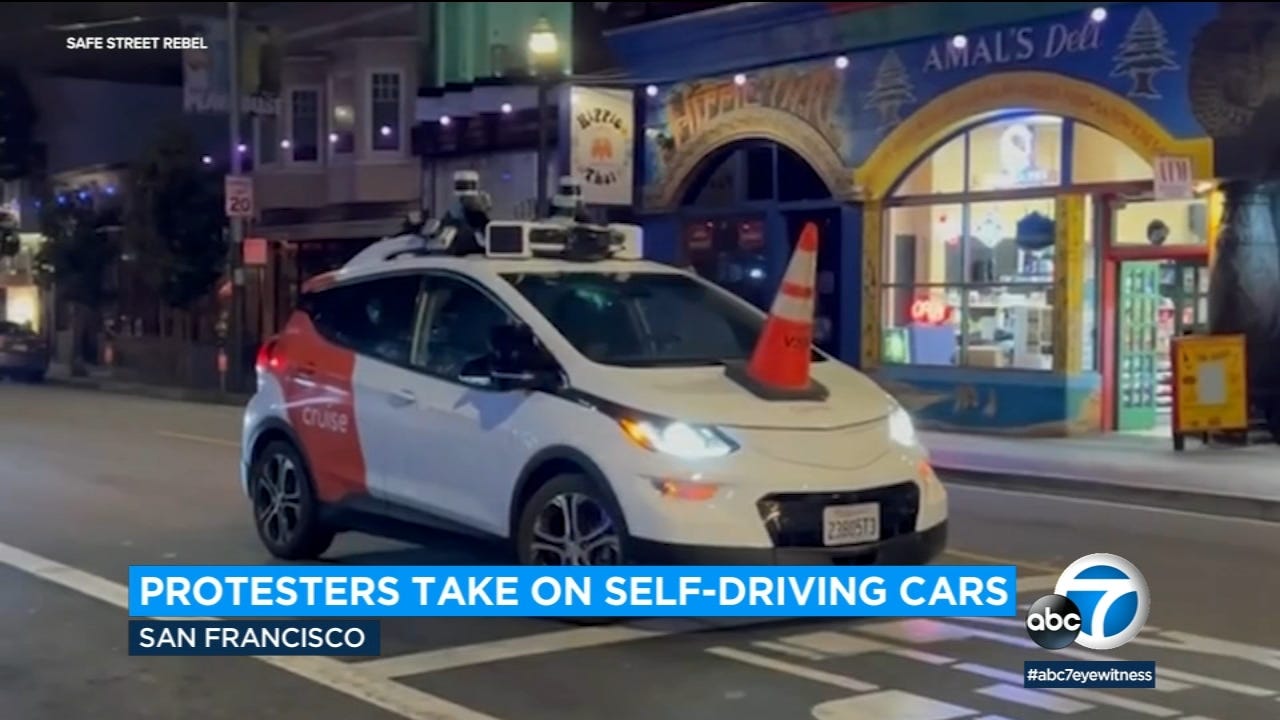
As people come to realize they can walk in front of self-driving cars with impunity the industry will lobby for dedicated self-driving lanes and streets that will be separated from pedestrians by fencing. These special self-driving car right-of-ways will allow for higher speeds. After all, they’ll be separated from pedestrians and be exclusive to self-driving vehicles. Such vehicles will be able to communicate with each other and function as a self-driving network powered by artificial intelligence. Not only will they be able to move faster due to pedestrian-free streets and network coordination, they’ll be cheaper for cities, too. With such a system, the need for signage, striping, and traffic signals (which cost more than you might imagine) is nullified. The network will be able to coordinate all of the vehicles moving through any given intersection so that none will need to stop. They will all be able to move between each other at high speeds, decreasing travel times and greenhouse gasses!
In this scenario human driven vehicles would be at such a disadvantage that people would just stop driving and let the cars do it for them. But here’s the thing: Can you imagine living in such a city? Fenced off avenues, pedestrian overpasses, high levels of noise from tires rolling over asphalt and air flowing over metal bodies at speeds considered reckless by today’s standards. Streets would become unpleasant to walk on and public life would move indoors exclusively. This is what happened when the federal government bifurcated neighborhoods with freeways. Self-driving cars could end up doing this to our avenues and boulevards, killing downtowns, killing neighborhoods, and making our cities uglier than the federal highway system could ever imagine.
***
A culture without interest, charm, and meaning is one that won’t survive. So far, I don’t think that AI is congruent with these values. There’s a reason why people refer to AI generated content as “slop”. It seems like everything AI touches becomes uglier. For a culture to survive, those within it need to value it, propagate it, and adapt it to technological and social changes over time. They built a museum for Jimi Hendrix. I predict nobody will build one for the Velvet Sundown.
Can a culture continue to advance and flourish while embracing artificial intelligence or would it stagnate and die, forever trading its future potential for predictable results in the present? There’s no reason a generation of people wouldn’t destroy its own inherited slop-culture in order to create space for something beautiful and worth dying for. Perhaps some cultures in the universe have chosen such a path in order to protect themselves from boredom and thus from apathy. Maybe eschewing AI is a requisite step to becoming a space faring species that can warp space time, shut down the military capabilities of other advanced species, and pilot flying saucers without having to pay a monthly self-driving subscription fee. Sounds like a beautiful future to me.